


India has been actively promoting trade with Africa in recent years. To boost the country’s trade with the Sub-Saharan African region, the Government of India launched the “Focus: Africa” programme under the EXIM Policy. Target countries identified during the first phase of the programme include Mauritius, Kenya and Ethiopia. The Government of India provides financial assistance to various trade promotion organisations, export promotion councils and apex chambers in the form of Market Development Assistance under the “Focus: Africa” programme.
To promote bilateral and regional commercial relations with the COMESA Region, India’s
Exim Bank has extended Lines of Credit (LOCs) to support export of eligible goods on
deferred payment terms. The operative LOCs  covering this region include US$ 5 million each to the Eastern and
Southern African Trade and Development Bank (PTA Bank), the Industrial Development Bank
Ltd, Kenya, and the East African Development Bank (EADB). These Lines of Credit seek to
expand export of product groups identified as those with potential to enhance trade
between two regions. India's potential exports to these countries include machinery and
transport equipment, petroleum products, paper and wood products, textiles, iron and
steel, plastic and linoleum products, rubber manufactured products, agro products,
chemicals and pharmaceutical products. These countries can also be important sources for
import of petroleum, metallurgical goods, raw cotton, fruit, vegetables and
preparations, chemicals, non-metallic mineral manufactures, precious stones, textile
yarn, gold, nickel, and ferro-alloys. Further, these countries offer potential for
investment in sectors such as tourism, pharmaceuticals, electronics, computer software
and accessories, information technology related products, financial services and
textiles.
covering this region include US$ 5 million each to the Eastern and
Southern African Trade and Development Bank (PTA Bank), the Industrial Development Bank
Ltd, Kenya, and the East African Development Bank (EADB). These Lines of Credit seek to
expand export of product groups identified as those with potential to enhance trade
between two regions. India's potential exports to these countries include machinery and
transport equipment, petroleum products, paper and wood products, textiles, iron and
steel, plastic and linoleum products, rubber manufactured products, agro products,
chemicals and pharmaceutical products. These countries can also be important sources for
import of petroleum, metallurgical goods, raw cotton, fruit, vegetables and
preparations, chemicals, non-metallic mineral manufactures, precious stones, textile
yarn, gold, nickel, and ferro-alloys. Further, these countries offer potential for
investment in sectors such as tourism, pharmaceuticals, electronics, computer software
and accessories, information technology related products, financial services and
textiles.

India-Africa Bilateral Trade (2023 - 2030)
On another front, the southern Indian state of Andhra Pradesh has signed a preliminary deal with Kenya and Uganda to send 500 farmers to cultivate land in the East African nations. The Andhra Pradesh government has signed letters of intent with Kenya for 50,000 acres (20,234 hectares) and with the Uganda Investment Authority for 20,000 acres (8,000 hectares). The Indian farmers would work as entrepreneurs and landowners, not as labourers.
With East Africa lacking experienced manpower to till the land, Andhra Pradesh officials spotted a good opportunity to export its skilled manpower. Authorities in East Africa signed the agreements to give land on a 99-year-old lease to a farmers co-operative society from Andhra Pradesh. Land in Uganda is being given for $3.75 dollars per acre while the government is still negotiating the price for Kenya.
“This is an 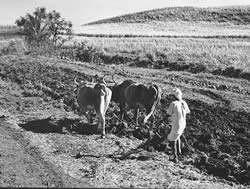 encouraging development. Our farmers
are very good at what they do but theyve been set back by droughts and a shortage of
fertile land. Now they'll be able to take full advantage of the land and infrastructure
in Africa,” said N Raghuveera Reddy, agriculture minister of Andhra Pradesh.
encouraging development. Our farmers
are very good at what they do but theyve been set back by droughts and a shortage of
fertile land. Now they'll be able to take full advantage of the land and infrastructure
in Africa,” said N Raghuveera Reddy, agriculture minister of Andhra Pradesh.
In another development, the Indian government opened a business centre in Durban
to help cut the red tape in deals between the two nations. With more Indian businessmen
looking to gain a foothold in South Africa, a high-powered delegation headed by India's
wealthiest man, industrialist Ratan Tata, visited the country recently. Already Tata
Motors and its rival, Indian car giant Mahindra & Mahindra, have made inroads into the
South African motor industry with the recent launch of new vehicles. Tata Africa
Holdings, a subsidiary of the Tata Group, is vying for a controlling stake in South
Africa's second telephone network operator worth more than Rands 4 billion. Total
bilateral trade betwen India and South Africa is approaching Rand 6.5 billion, with
imports from India at Rand 3.12 billion and exports to India at Rand 3.35 billion.
Indian investment in South Africa is estimated at $100 million.
Did You Know?


