The Dar es Salaam International Trade Fair (DITF) has established itself as one of the prime trade events in East Africa. Held every year, the DITF is an ideal platform for companies to showcase their products on a pan-African platform. The DITF has grown in stature over the years and attracts more than 1,000 companies from all over the world to participate annually. In addition to companies from Tanzania and the rest of Africa, one can find a large contingent of overseas companies from as far away as the United States, Europe, India, Pakistan, and the Middle East.
While in Tanzania for the DITF, many participants also use the opportunity to visit Zanzibar, which has emerged as an important business 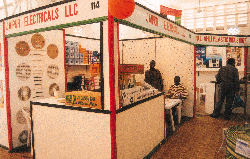 centre in the region. In recent years, Zanzibar has established itself as an essential destination for exports and re-exports. The Maruhubi port in Zanzibar operates as a free port; imports routed here are exempt from custom duties and import taxes. Merchants and traders are permitted to store their cargo at the port before re-shipping them elsewhere for sale or use. When re-shipping imports stored at the free port, traders are required to pay custom duties only in the country of the goods' final destination. This strategic advantage has helped Zanzibar rapidly emerge as the distribution hub of the East African region.
As a result, goods from all parts of the world are shipped to Zanzibar for further re-export and distribution into the East African countries of Uganda, Burundi, Rwanda, and the Democratic Republic of Congo.
In view of the increased cargo traffic through the Zanzibar port, the government is continuously upgrading its facilities. Major development programmes have modernized existing infrastructure and increased the port's handling capacity, earning it the moniker "Dubai of East Africa."
 The port is designed to distribute goods seamlessly to the mainland and landlocked countries in the hinterland. The 32,000 square metre facility features a specialized container stocking yard, all-weather warehousing sheds, and a motor vehicle yard capable of stocking a large volume of automobiles. Consequently, cargo movement in Zanzibar has registered a marked increase, handling hundreds of thousands of tonnes of general break-bulk cargo and tens of thousands of tonnes of liquid cargo, alongside a rapidly growing container throughput.
Imports into Tanzania have registered steady growth. Progressive economic liberalisation policies adopted by the government, coupled with a sustained economic boom, have played an instrumental role in promoting trade. Tanzania's exports have also expanded significantly, with fresh fruits, vegetables, handicrafts, agricultural products, minerals, and tea leading the market.
Automobiles, heavy machinery, consumer electronics, chemicals, second-hand cars, spare parts, textiles, and computing equipment are among the top items imported into Tanzania on a regular basis.
 According to industry estimates, large volumes of second-hand cars are exported to Tanzania through hubs like Sharjah every month. These right-hand drive cars are heavily sourced from Japan and shipped to meet local demand. "There is a huge demand for quality second-hand cars in Tanzania. Second-hand car dealers in Sharjah and Dubai have been major sources in meeting this increasing demand," noted local traders. The trading ecosystem has been further boosted by government initiatives to streamline foreign exchange regulations, making it easier for Tanzanian businessmen to finalize overseas purchases.
Dar es Salaam, the country's primary seaport, serves as the central distribution hub for huge East African markets by providing direct access to landlocked neighbouring nations. The port is linked to the world's major maritime routes with regular sailings to Europe, the Americas, Asia, and the Middle East. With a population exceeding 8 million people, Dar es Salaam is the largest city in East Africa and a major industrial and transportation terminus. Tanzania has fully liberalised its economy by removing historical obstacles that hampered the free flow of trade and foreign private investment, creating a highly conducive environment to attract global capital.
Top 10 Non-Oil Import Commodities in Tanzania
(Est. Value USD Millions)

© Africa Business Pages
Source: OEC Trade Statistics & Regional Estimates, 2025
Latest Economic & Trade Developments
Tanzania’s economy demonstrated robust performance in 2025, reaching a GDP growth rate of 6.0%, and is projected to expand by 6.3% in 2026. This growth trajectory is strongly supported by the completion of major infrastructure initiatives, notably the Julius Nyerere Hydropower Project, which adds 2,115 MW of capacity to the national grid, and the ongoing expansion of the Standard Gauge Railway. Furthermore, Tanzania achieved a record-breaking $10.95 billion in approved investments across 915 projects in 2025, signaling a massive surge in foreign and domestic capital targeting the manufacturing, mining, and energy sectors.
Despite global economic headwinds, the country has maintained vital macroeconomic stability. Headline inflation averaged a controlled 3.3% in 2025, comfortably remaining within the Bank of Tanzania's target range of 3–5%. The mining sector emerged as a star performer, recording a 19% growth rate in early 2025 and generating a record $4.7 billion in gold exports. These revenues, coupled with foreign exchange reserves strengthening to $6.3 billion—enough to cover nearly five months of imports—provide a solid fiscal buffer as the country targets $15 billion in annual foreign direct investment by 2026.
Did you know?